Staging Power: Mise-en-Scène and Spatial Hierarchy in Osaka Elegy
In Osaka Elegy, director Kenji Mizoguchi frequently uses long takes and carefully orchestrated mise-en-scène to communicate character relationships and shifting power dynamics within a scene. In film theory, “mise-en-scène” refers to the arrangement of everything visible within the frame, including lighting, blocking, actor movement, framing, and performance, and how these visual elements work together to produce meaning. Rather than relying heavily on editing, Mizoguchi often allows the viewer to observe these elements unfold within a single continuous shot.
A particularly revealing example occurs in a sixteen-second shot (35:46–36:02) in which Ayako debates how to explain her new appearance to Susumo. In this moment, the film’s staging, lighting, and actor movement subtly convey a shift in the relationship between the two characters. Through careful blocking and spatial composition, the scene visually represents Ayako’s temporary ability to regain a small sense of control in a life otherwise dominated by male authority. By closely examining the mise-en-scène of this shot, it becomes clear how Mizoguchi uses staging and movement within the frame to communicate changes in emotional state and power without relying on explicit dialogue.
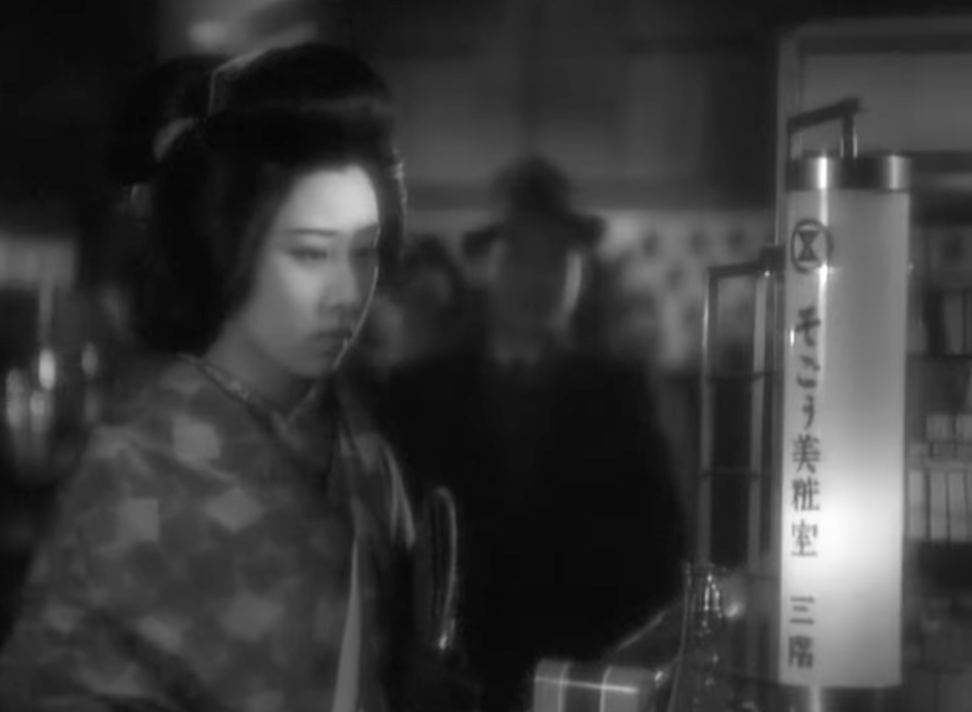
The shot begins with Ayako turning her back away from Susumo and toward the camera because she is ashamed to admit why her hair has changed since he last saw her. Ayako occupies the foreground and is sharply in focus as she stares into a blinking light positioned on camera right, while Susumo remains out of focus in the shadowy background. Although Ayako is illuminated by a noticeable hotspot on the right side of her face and is clearly more visible than Susumo, she is not centered in the composition. Instead, she stands slightly off-center to camera left, while Susumo occupies the center of the frame. This spatial arrangement establishes what film theorists often call a visual hierarchy within the frame: the character positioned centrally often retains greater narrative authority even when another figure appears more visually prominent.
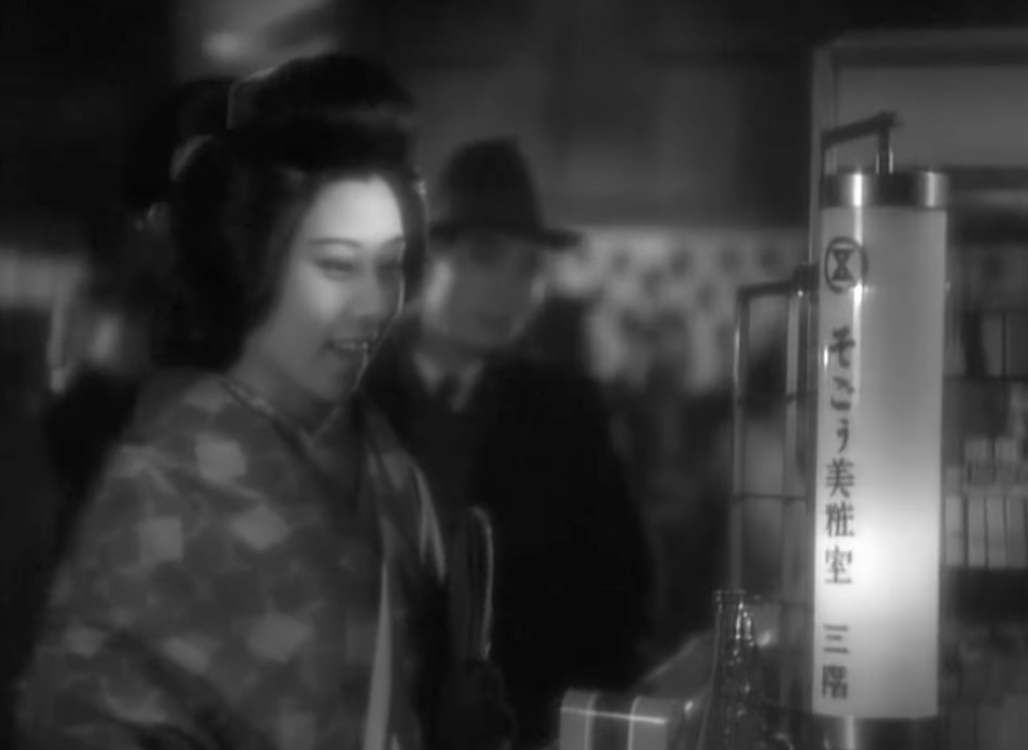
Three seconds into the shot, Ayako begins to smile as Susumo slowly approaches her from behind. Before he can reach her, however, she pivots to face him, bringing him into focus in the center of the frame, and confidently declares her fabricated story about working at a beauty parlor. Continuing to improvise details about this fake job, Ayako walks directly toward Susumo while speaking before completing her sentence and exiting camera left. Susumo pauses momentarily, mouth agape, then follows after her, exiting camera left while asking, “Is that so?”
At the beginning of the shot, the audience observes Ayako performing a gesture that has recurred multiple times throughout the film: turning away from a male figure in shame. This blocking choice recalls the power dynamic established earlier between Ayako and the men who exert control over her life. An early example occurs at 12:16, when Mr. Asai asks Ayako to become his mistress and she turns away from him in embarrassment and discomfort. By repeating this staging, the film visually reminds the audience of the established hierarchy between Ayako and the male figures around her. The spatial arrangement of the frame reinforces this imbalance. Although Ayako occupies the foreground and receives stronger lighting, she remains off-center, while Susumo—despite being in shadow and out of focus—remains centered. This compositional choice suggests that the narrative gravity of the scene still revolves around Susumo rather than Ayako, indicating that she has not yet fully escaped the structures controlling her life.
The lighting and performance further communicate Ayako’s emotional state. The illumination on her face allows the viewer to clearly see that her mouth turns downward and her eyebrows are slightly furrowed, signaling visible distress. However, roughly three seconds into the shot, the mood shifts as Ayako begins to smile in a way that resembles someone arriving at a sudden realization. This small but deliberate acting choice signals to the audience that Ayako has devised a solution in the moment. Immediately after this expression appears, she invents the lie that she has been working at a beauty parlor.
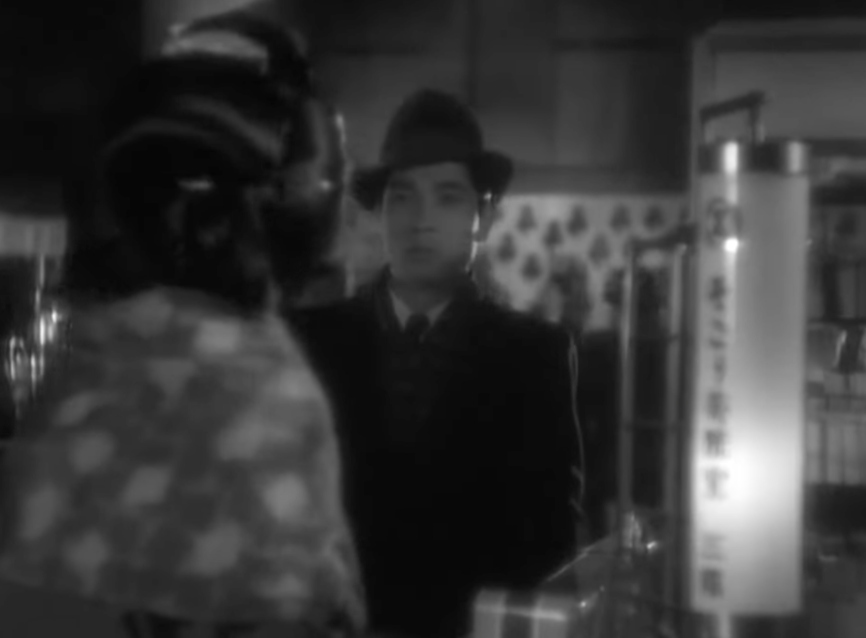
The staging of the scene then begins to reverse the earlier power dynamic. Just as Susumo begins to approach her, Ayako turns to face him directly, halting his movement. This pivot represents a crucial shift in the scene’s spatial power relations: rather than retreating, Ayako confronts him. She not only faces Susumo while delivering her explanation but also begins to walk toward him as she elaborates on her story. Her forward movement contrasts with Susumo’s sudden stillness, emphasizing her temporary control over the interaction. Through this blocking, the film transfers momentum—and therefore authority—toward Ayako, demonstrating how movement within the frame can reshape power dynamics without the need for a cut.
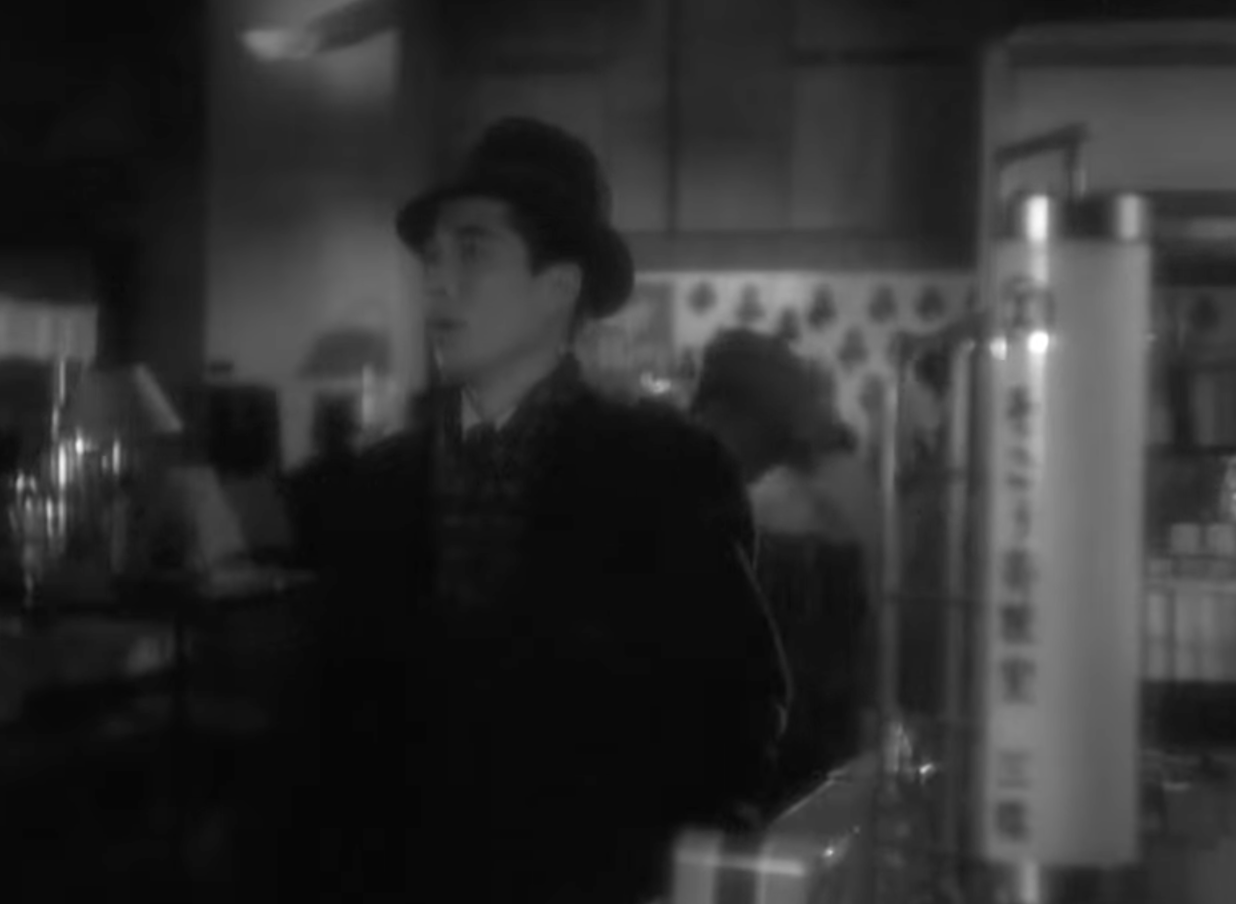
The shot concludes with Ayako exiting frame left while Susumo remains momentarily frozen in place, processing what he has just heard. After pausing, he follows her out of the frame, asking, “Is that so?” His delayed reaction suggests that Ayako’s performance has successfully destabilized him. In this moment, he becomes the character who must react and pursue rather than command or interrogate. Through the combined use of framing, lighting, performance, and actor movement, the mise-en-scène communicates a subtle but significant emotional shift: Ayako appears more confident and momentarily capable of directing the interaction. Although this shift may be temporary within the larger narrative, the shot demonstrates how Mizoguchi’s long-take style allows character psychology and shifting power dynamics to emerge organically through staging rather than editing.
