Watching the Frame Think: Explicit and Implicit Narratives in Les Vampires
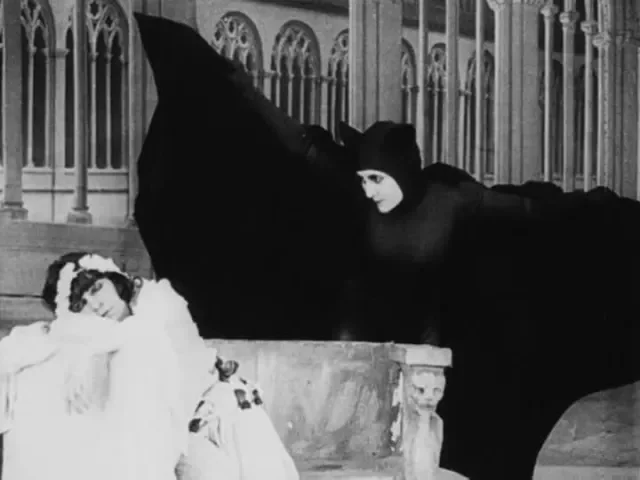
There’s something strangely modern about Les Vampires (Louis Feuillade, 1915). Not because of its pacing or spectacle, but because of how much the film trusts viewers to read the frame for themselves. Long before rapid editing or moving cameras became standard cinematic language, Feuillade creates tension almost entirely through staging.
The camera barely moves.
The frame does all the work.
What fascinates me most about Les Vampires is the way it operates on two narrative levels at once. There is the explicit narrative communicated through intertitles and large physical gestures, and then there is the implicit narrative hidden within the positioning of bodies, props, and gazes inside the frame.
The sequence involving Miss Simpson, Philippe, and the doctor is one of the clearest examples of this.
The intertitle introduces the scene plainly enough: Philippe recounts the violent exploits of the Vampires gang after dinner. Words like “sinister” and “exploits” immediately establish danger before the audience even sees the characters.
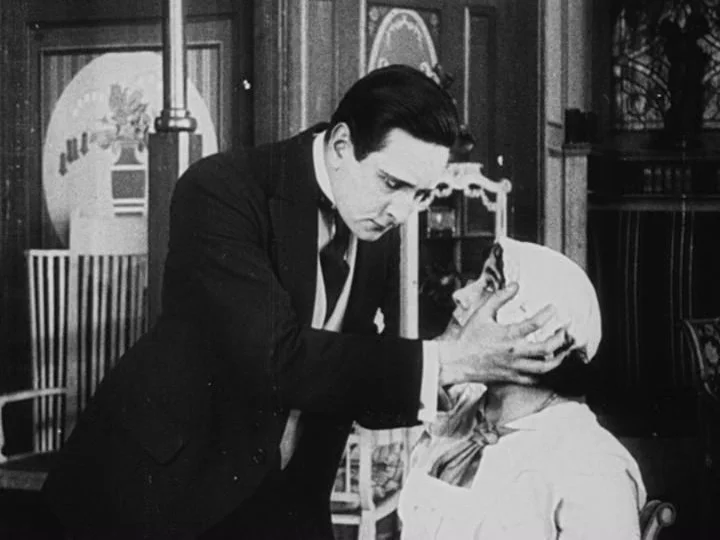
But the real tension of the scene comes from the doctor.
From the beginning, Feuillade’s staging establishes a hierarchy of power. The doctor stands upright in the center of the frame while Miss Simpson and Philippe sit beneath him. The composition alone gives him authority. His posture reinforces it further. He stands casually with one hand on his hip and a cigarette hanging from the other hand, emotionally detached from the conversation around him.
Everyone else reacts.
The doctor watches.
That difference becomes increasingly suspicious.
While Philippe recounts the crimes of the Vampires with widened eyes and dramatic gestures, the doctor remains almost expressionless. His emotional stillness feels unnatural compared to the fear expressed by the other characters. Before the film reveals anything directly, the audience already begins to distrust him simply because he appears too calm inside the frame.
Feuillade constantly redirects viewer attention through gesture and object placement rather than editing. One character’s movement motivates another character’s reaction. Philippe pantomimes a throat-slitting gesture while describing the gang. Miss Simpson recoils in horror. The doctor subtly intervenes as though trying to stop the conversation from continuing.
Every gesture contains narrative information.
Because the camera remains static, the audience becomes hyperaware of spatial relationships within the shot itself.
The jeweled cigarette case becomes the clearest example of this visual storytelling.
The object gradually turns into the center of the sequence not because the film cuts toward it repeatedly, but because Feuillade constantly guides viewer attention back toward the bottom center of the frame. Characters pass objects through that area deliberately. Props appear there with increasing narrative importance. The audience begins unconsciously associating that location with meaning.
When Philippe admires Miss Simpson’s cigarette case, Feuillade briefly inserts an extreme close-up so viewers can appreciate the jewels catching the light. Explicitly, the shot communicates that the object is valuable.
Implicitly, something else is happening.
The doctor’s hand hovers ominously above the case in the background while holding a cigarette. The positioning makes his hand appear almost predatory, as though he is psychologically reaching for the object before physically taking it.
It is a surprisingly threatening image for such a simple composition.
The scene becomes even more layered once the tray of alcohol enters the frame.
After the doctor retrieves the drinks, Feuillade visually replaces the cigarette case with the alcohol tray in the same lower-center position within the shot. The audience unconsciously links the two objects together before the narrative explicitly explains their relationship. Later, we discover the doctor has drugged the alcohol in order to steal the cigarette case and frame Philippe.
The frame understands the connection before the audience consciously does.
That is what makes the sequence feel so sophisticated even today. The film is not simply documenting action. It is teaching viewers how to interpret visual relationships inside cinematic space.
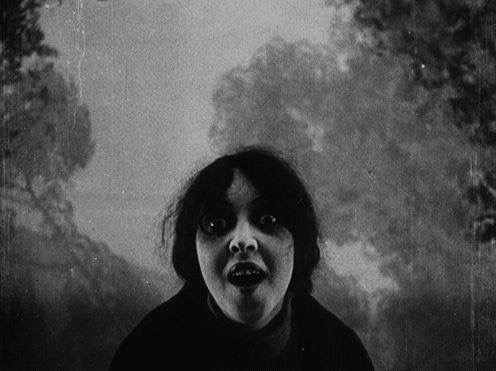
This is also why physicality matters so much in silent-era performance. Modern audiences sometimes dismiss silent film acting as exaggerated, but in Les Vampires, gesture functions almost like dialogue.
One of the creepiest moments occurs near the end of the sequence when the doctor watches Miss Simpson after offering her the drugged drink. He casually smokes while staring at her with unnerving focus, tilting his head slightly as though waiting for an experiment to succeed. When she suddenly becomes exhausted, he appears completely unsurprised.
The explicit narrative tells us she became tired.
The implicit narrative tells us the doctor already knew she would.
That distinction between what the film says and what the frame reveals is what makes Les Vampires so important historically. During the Transitional Era of cinema, filmmakers had not yet fully standardized modern continuity editing. Directors like Feuillade instead developed meaning through staging, object placement, depth, and movement within the frame itself.
The camera does not chase the narrative.
The narrative emerges from how figures occupy space.
Watching Les Vampires today feels like watching cinema discover how to think visually.
