How Cinema Remembers the AIDS Crisis
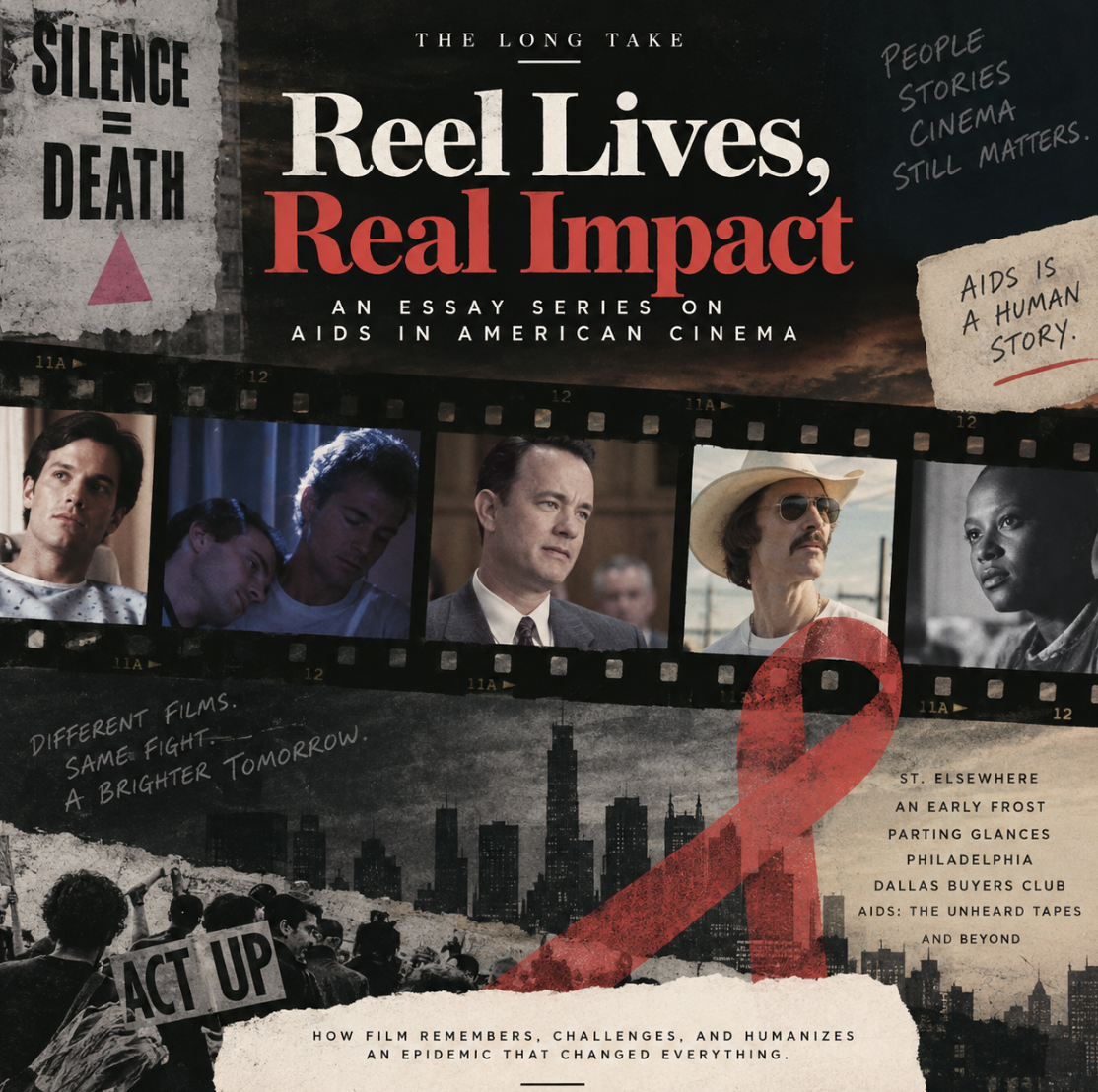
Part III of The AIDS Film Canon
Every historical film is a reconstruction. Someone selects the images. Someone chooses where the story begins. Someone decides which experiences become representative and which remain outside the frame. That problem becomes particularly complicated when cinema returns to the AIDS crisis, because the archive is now enormous: news broadcasts, activist footage, photographs, home movies, oral histories, medical records, interviews, previous documentaries, and decades of fictional representations. Contemporary filmmakers are not working with an absence of material. They are working under the weight of everything that has already been seen.
That makes the evolution from Philadelphia to Dallas Buyers Club particularly interesting. Released in 2013, Jean-Marc Vallée's film returned AIDS to the center of an American prestige drama but chose a dramatically different protagonist. Matthew McConaughey's Ron Woodroof is abrasive, homophobic, aggressively masculine, and initially convinced that AIDS belongs to a category of people entirely separate from himself. His diagnosis destroys that distinction. Much of the film then follows his efforts to obtain and distribute unapproved treatments outside conventional medical channels while his relationship with Rayon, a fictional transgender woman played by Jared Leto, increasingly places him among people he once regarded with contempt.
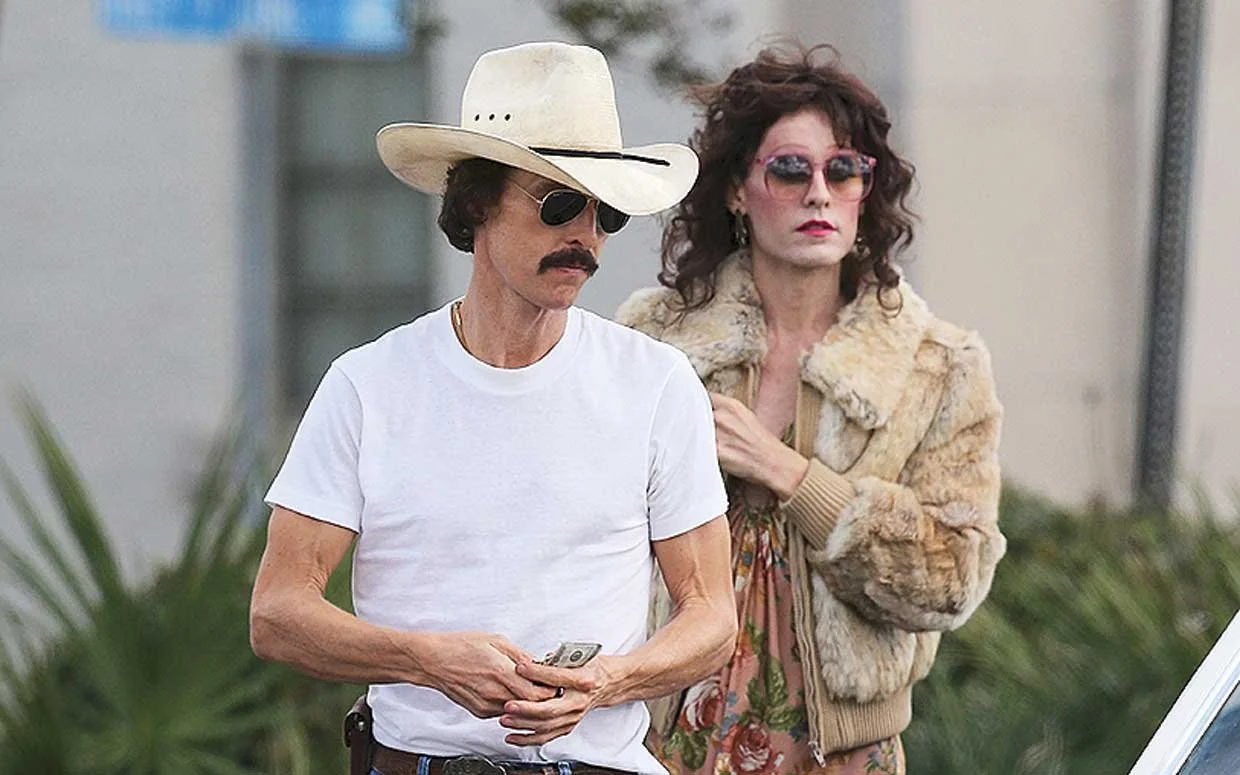
The film therefore returns to one of the oldest devices in mainstream AIDS representation: the “unexpected” patient. Like the politician in St. Elsewhere, Ron complicates an audience's assumption that AIDS can be confined to one recognizable identity. But by 2013, that narrative device has acquired a different meaning. The cultural problem is no longer simply convincing viewers that heterosexual people can acquire HIV. Instead, Dallas Buyers Club uses Ron's outsider status as the audience's entry point into conflicts over treatment access, medical authority, regulation, prejudice, and the community formed around the epidemic.
That framing is also the film's central representational problem. Once again, a major Hollywood movie about a crisis that devastated gay communities places a heterosexual white man at the center of the narrative. Critics noticed the tension when the film was released: Ron can function as an accessible route into a stigmatized world precisely because he begins outside the population most associated with AIDS. The issue is not that his perspective has no place in AIDS cinema. It is that prestige filmmaking always participates in canon formation. The stories receiving major stars, financing, awards attention, and cultural permanence tell us something about which perspectives Hollywood expects a mass audience to follow.
That concern becomes even more important once AIDS moves from contemporary event into remembered history. A fictional film selects a protagonist. A documentary selects an archive. Neither selection is neutral. A historical event can contain millions of experiences, but cinema can only present some of them. The question is not simply whether the resulting movie is “accurate.” It is also: whose memory becomes the memory?
This is where AIDS: The Unheard Tapes becomes such an extraordinary counterpoint to prestige films such as Philadelphia and Dallas Buyers Club. The three-part BBC documentary, first broadcast in 2022, draws heavily from oral-history recordings now preserved by the British Library. One collection began recording gay and lesbian people in Britain in 1985 and continued into the early 1990s; another contains life-story interviews with people living with HIV and AIDS recorded primarily from 1995 to 2000, with some participants later re-interviewed. Instead of hiring actors to recreate those stories in a conventional dramatic form, the series does something stranger: it preserves the historical speakers' actual voices while actors lip-sync their words on screen.
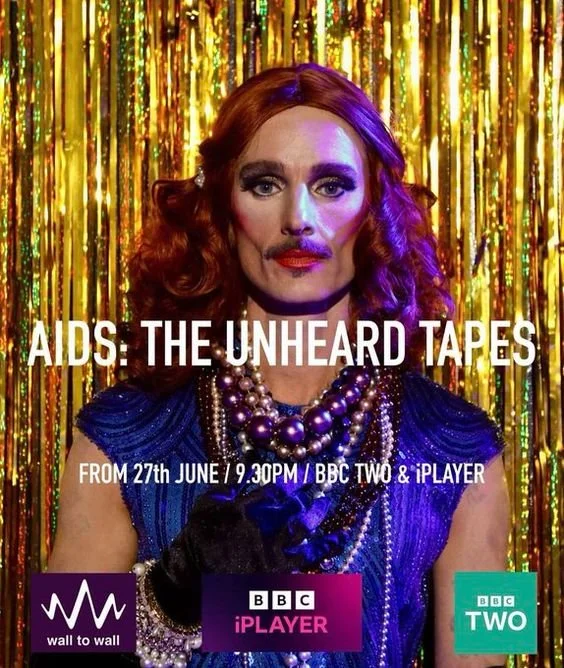
On paper, that sounds dangerously close to a gimmick. Documentary reconstruction often invites exactly that criticism: if the testimony already exists, why stage it? Lucy Mangan opened her Guardian review by expressing skepticism about reconstructions in documentaries, then described The Unheard Tapes as an exceptional case because its lip-sync technique brings viewers closer to voices recorded during the crisis. The British Library confirms that the voices themselves are the original archival recordings, while actors provide contemporary physical embodiments for them.
The result creates an uncanny separation between body and voice. We know the person we are seeing is not the person speaking. The actor's face belongs to the present; the recorded voice belongs to the past. Yet rather than weakening the testimony, the distance between the two becomes the documentary's central expressive device. A voice that might otherwise play over archival photographs suddenly seems attached to a breathing body. A chair becomes occupied. A face reacts. Someone appears to look back at us.
Crucially, the actors do not replace the original speakers. Their accents, rhythms, pauses, jokes, hesitations, fear, anger, and personality remain audible because those elements come from the recordings themselves. What the reconstruction restores is not historical authenticity in the literal sense—the film never pretends these are the original bodies—but a form of cinematic presence. The documentary openly acknowledges that the past cannot be physically recovered and then uses performance to dramatize the very distance separating us from it.
That is why the common argument that reconstruction merely repeats pre-existing historical material feels inadequate. The material may not be new. The encounter with it can be. Cinema has never functioned as a neutral storage device. Editing determines which images become connected. Framing tells us what deserves attention. Sound changes our emotional relationship to an image. Performance can alter how close we feel to testimony. Even placing an archival recording beside a particular photograph interprets that recording.
AIDS: The Unheard Tapes makes that process unusually visible because it refuses to hide its own act of reconstruction. We know these are actors. We know the voices belong to other people. We know that we are watching the present attempt to give shape to the past. That tension becomes part of the meaning rather than an obstacle to it.
The series also expands what counts as meaningful historical testimony. Its achievement is not merely preserving stories of illness and death. Contemporary reviewers noted the documentary's willingness to preserve humor, sex, pleasure, nightlife, friendship, and the joy of gay life before and during the crisis, rather than allowing AIDS to retroactively transform every remembered experience into tragedy. That choice matters enormously. If historical films remember people only at the moment they become victims, they reproduce a different kind of erasure. A life remembered exclusively through the disease that killed someone is still a life reduced.
Seen together, these films reveal how radically the cinematic meaning of AIDS has changed. An Early Frost asks a mainstream audience to recognize that a gay man with AIDS deserves love. Parting Glances allows AIDS to exist within a gay social world without allowing disease to swallow the rest of that world. Philadelphia turns mainstream attention toward stigma and discrimination. Dallas Buyers Club reframes the epidemic around treatment access, authority, and resistance while simultaneously raising questions about whose perspective Hollywood chooses to center. AIDS: The Unheard Tapes confronts a different problem altogether: how do we preserve the voices of people whose experiences are becoming history?
These films do not simply replace one another as representation becomes more sophisticated. They remain in conversation. Each new AIDS film enters a cinematic landscape already crowded with previous images: the tragic patient, the frightened family, the stigmatized outsider, the activist, the survivor. A filmmaker can repeat those images, challenge them, or recover voices earlier films ignored. This is what makes reinterpretation valuable. The archive may stay the same, but culture does not. Every generation approaches the history of AIDS from a different distance and with different assumptions about sexuality, medicine, stigma, identity, survival, and memory.
The history of AIDS on screen is therefore also a history of changing cultural permission: who could be shown, who could be sympathetic, who could be sexual, who could be angry, who could be complicated, who could tell the story, and eventually who would be remembered.
That is why reconstruction matters. History does not remain culturally alive simply because someone recorded it once. Cinema preserves the past by continually changing our relationship to it.
The best films about AIDS do more than tell us what happened.
They reveal how every era has chosen to look at what happened — and, sometimes, teach us how to look again.
