Philadelphia and the Moment AIDS Cinema Entered Mainstream Hollywood
Part II of The AIDS Film Canon
By the time Philadelphia opened in December 1993, AIDS had already been represented on American screens for a decade. Gay and independent filmmakers had gone much further than Hollywood in depicting the epidemic, and television had already brought AIDS into millions of homes. So calling Philadelphia the beginning of AIDS cinema would erase precisely the artists who had been willing to confront the crisis while the major studios hesitated. What Philadelphia represents instead is something narrower but culturally enormous: AIDS becoming the subject of a major Hollywood prestige drama, backed by a large studio, directed by Jonathan Demme, and carried by two of the most recognizable actors in American cinema. Contemporary coverage routinely described it as the first major Hollywood studio film to make AIDS and homophobia its central subject.
That distinction changes how the film should be understood. Philadelphia did not invent serious AIDS cinema. It translated it into the language of mainstream Hollywood. Tom Hanks plays Andrew Beckett, a successful attorney who believes he has been fired after the partners at his law firm discover that he has AIDS. He hires personal injury lawyer Joe Miller, played by Denzel Washington, to bring a discrimination case against the firm. AIDS therefore enters the film not simply as a biological condition but as the catalyst for a story about work, law, prejudice, privacy, homosexuality, and the boundary between fear and discrimination. Andrew is sick, but his illness does not fire him. People do.
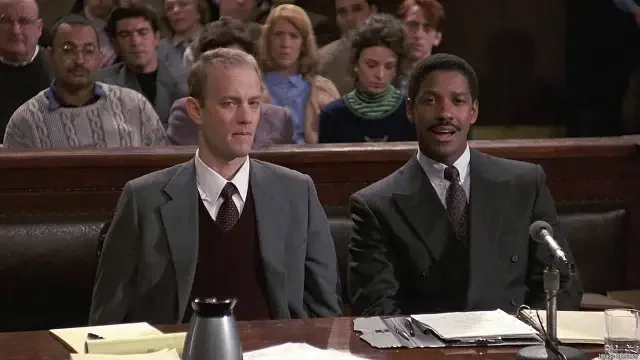
Philadelphia by Jonathan Demme, 1993
That shift toward social consequence fits a much broader pattern in films about epidemics. In a 2020 JAMA analysis of infectious-disease cinema, Walter Dehority identified “stigmatization of the other” as a recurring theme, particularly prominent in films about HIV and plague, and cited Longtime Companion and Philadelphia as examples. This is a more useful way to think about Philadelphia than treating it as the moment an entirely new genre appeared. The film participates in a longstanding cinematic fascination with the boundary between infected and uninfected, safe and dangerous, innocent and guilty. What makes AIDS particularly revealing is how quickly those medical categories become social ones.
One of Philadelphia's smartest choices is therefore making Joe Miller almost as important to the film's argument as Andrew himself. When Andrew initially approaches Joe, Joe is deeply uncomfortable around him. He misunderstands HIV transmission. He recoils from homosexuality. His reaction is ugly, but it is also deliberately recognizable. Joe functions as a surrogate for the mainstream audience that Philadelphia was designed to reach. The movie does not flatter that audience by assuming it has already arrived at the correct moral position. Instead, it stages prejudice and then dramatizes its gradual erosion.
That makes the film politically complicated. On one hand, filtering Andrew's story partly through a heterosexual man's education makes Philadelphia less radical than films that begin entirely within queer life. On the other, that structure almost certainly helped the movie reach viewers who might never have seen Parting Glances or other earlier AIDS films. Philadelphia grossed more than $200 million worldwide and turned a story about AIDS discrimination into mass-market Hollywood cinema. Its achievement was not originality so much as scale.
The film repeatedly turns looking itself into a moral act. Andrew's Kaposi sarcoma lesions become something other characters notice before they know how to respond to him. In the law library, awareness of his illness changes the atmosphere around his body. In the courtroom, his physical deterioration becomes impossible to separate from the case being argued. And then there is the film's most famous sequence: Andrew listening to Maria Callas sing “La mamma morta” while Joe watches him. The legal drama briefly falls away. Andrew translates and responds to the aria with overwhelming emotion, the lighting bathing him in red as Joe sits almost silently across the room. It is an unusually theatrical moment in an otherwise restrained prestige drama, but its excess is exactly the point. Joe is forced to encounter an interior life far larger than the stereotype through which he initially understood Andrew.
The scene crystallizes Philadelphia's strategy. We are not simply watching Andrew. We are watching someone learn how to watch Andrew. Joe does not become gay, sick, or suddenly free of every prejudice. He becomes capable of recognizing the humanity of someone he had previously kept at a psychological distance. For a mass audience, the film offers the same invitation.
Yet the strategy also reveals the film's limitations. Philadelphia is remarkably careful about how it presents homosexuality. Andrew is given a loving partner, Miguel, played by Antonio Banderas, but their physical intimacy remains restrained. The AFI catalogue notes that more intimate domestic material was removed in editing and that critics at the time questioned the absence of a kiss between the two men. It also documents how TriStar's marketing often deemphasized AIDS and homosexuality in favor of selling the movie as a courtroom drama. Even as Hollywood finally centered a gay man dying of AIDS, it remained visibly anxious about how much gay intimacy a mainstream audience would tolerate.
Andrew himself is likewise an almost ideal candidate for mainstream sympathy: educated, successful, cultured, loving, and played by Tom Hanks. The film challenges prejudice while simultaneously choosing a protagonist whose respectability makes that challenge easier. That does not negate what Philadelphia accomplished. It does, however, continue a question that had existed since the earliest AIDS narratives: which people with AIDS does mainstream culture find easiest to mourn?
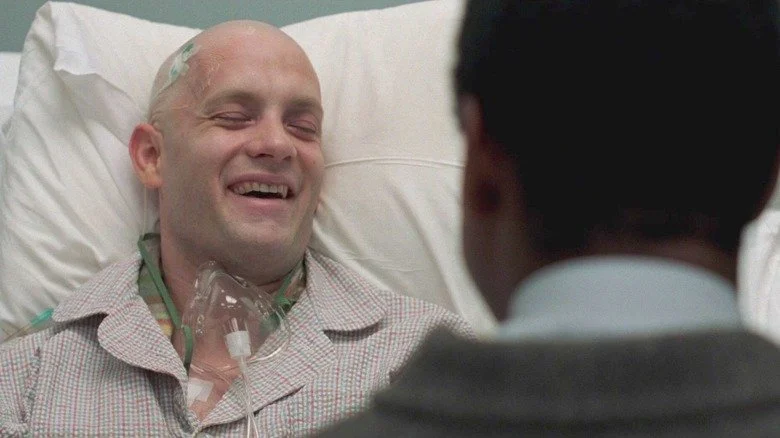
The difference is that Philadelphia makes sympathy only the beginning of its argument. Earlier mainstream AIDS dramas often centered the sadness of diagnosis and the pain experienced by families. Philadelphia directs more attention toward the systems surrounding that pain. AIDS is tragic, but discrimination is not inevitable. Fear of infection may be culturally widespread, but ostracism is still something people choose to enact. A virus causes illness. A society decides what illness will mean.
That distinction is the source of the film's anger. Philadelphia ultimately says something more confrontational than “this man deserves your compassion.” It says: this man has been wronged. Sympathy positions the viewer beside suffering. Anger asks the viewer to identify its cause.
And once AIDS cinema begins asking that question, its field of vision expands. The story can move outward toward employers, government, pharmaceutical systems, medical authority, inequality, activism, and the politics of whose suffering becomes publicly visible. Films made afterward would pursue those questions in very different ways. Dallas Buyers Club, released twenty years later, would again turn AIDS into prestige cinema, but its imagined route into the epidemic would look almost nothing like Andrew Beckett's.
By then, another transformation was underway as well. The earliest years of AIDS were moving from immediate crisis into history. Cinema was no longer responsible only for representing an epidemic unfolding in the present.
It was becoming responsible for remembering one.
