Leaving Scottie in the Dark
Staging and the Hierarchy of Knowledge in Vertigo
In Vertigo, Alfred Hitchcock uses staging to subtly reveal the film’s hierarchy of knowledge—particularly the imbalance between Scottie Ferguson (Jimmy Stewart) and Judy Barton (Kim Novak). For roughly the first two-thirds of the film, narration is restricted to Scottie’s perspective. The audience therefore knows only what Scottie knows, and the deception surrounding Gavin Elster (Tom Helmore) is not fully revealed until the narrative expands to include Judy’s knowledge later in the film.
Yet even before the plot’s secret is explicitly disclosed, Hitchcock’s staging quietly suggests that Judy possesses greater knowledge and control. Across the three shots analyzed here, Scottie is repeatedly confined to shadowed spaces and restricted movement, while Judy occupies well-lit environments and moves freely within them. These visual patterns subtly foreshadow the power imbalance between the two characters. Although Scottie appears to be the active pursuer during much of the film, the staging of these scenes suggests that Judy holds the upper hand.
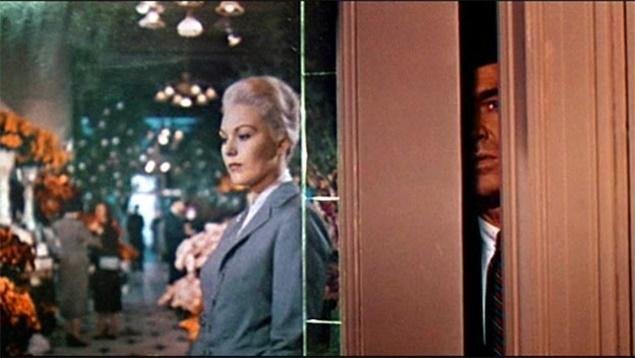
Watching from the Shadows (Flower Shop, 21:22–21:27)
One of the earliest and most explicit examples of this staging dynamic occurs when Scottie follows Judy into a flower shop and observes her through a partially opened door.
At the beginning of the shot, Judy is visible through a mirror as she moves from the left side of the frame toward the center before drifting back toward her starting position. The flower shop surrounds her with bright color and illumination: rows of vivid flowers and hanging chandeliers fill the frame with light. As she approaches the center of the shot, Judy turns her body slightly left and gazes upward offscreen, exposing her profile.
Scottie watches her from the dark hallway outside the shop. Only a narrow sliver of his face and upper torso is visible through the crack in the door. The dim hallway casts shadows over his face, and he remains almost completely motionless as he studies Judy. The only light that touches him seems to spill faintly from the brightly lit room he is observing.
The contrast between the two characters is striking. Judy moves freely throughout a large, colorful space, while Scottie remains fixed in darkness. Her constant movement suggests freedom within the frame, whereas Scottie’s position confines him physically and visually. This contrast mirrors their positions in the film’s hierarchy of knowledge. At this moment, Scottie is unaware of Elster’s plot, while Judy already knows the deception in which she is participating. Scottie’s literal position in darkness therefore reflects his metaphorical state of being “in the dark,” while Judy’s presence in the light subtly signals her greater awareness of the situation.
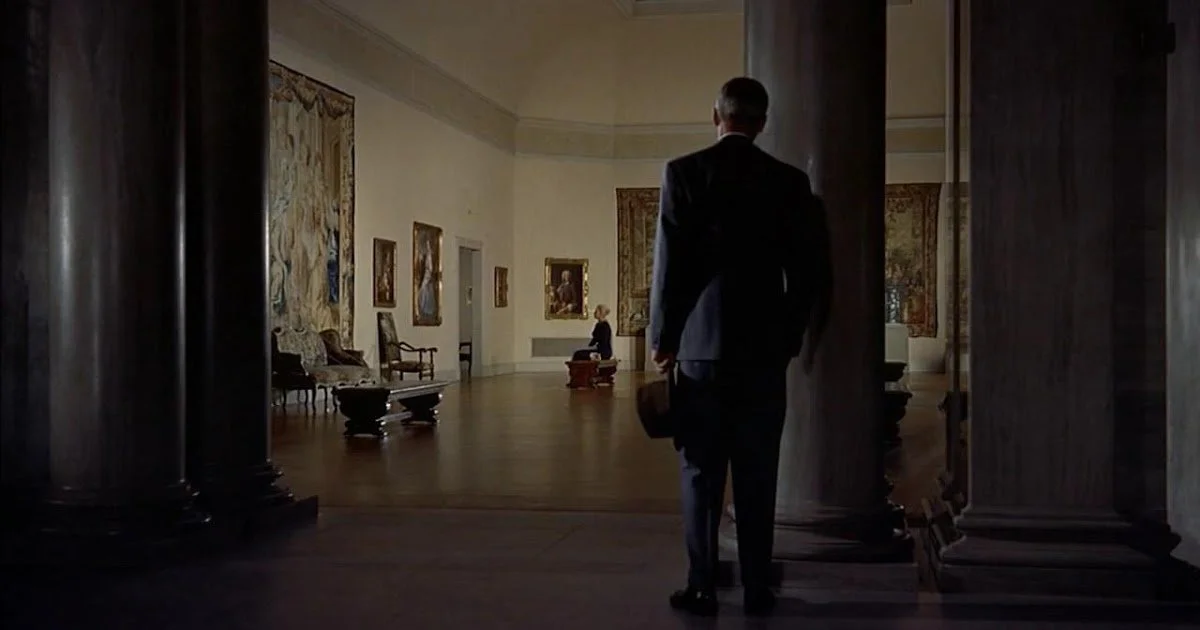
2. Movement Dictated by Judy (Art Museum, 40:40–41:00)
A similar dynamic appears later in the museum scene, where Scottie watches Judy sit before the portrait of Carlotta Valdes.
At the beginning of the shot, Scottie stands in a dim hallway with his back to the camera. He watches Judy from a distance as she sits centered in the brightly lit gallery. The museum room is filled with colorful paintings illuminated by strong lighting, while the hallway where Scottie stands remains shadowy and subdued.
For several seconds, Scottie does not move at all. When Judy begins to gather her belongings at 40:45, he shifts slightly behind a pillar to remain hidden. Judy then walks toward the portrait and pauses, staring at it for several seconds before turning to exit the room. As she moves toward the hallway where Scottie stands, he slowly retreats before turning and leaving the frame to the right.
Once again, Scottie’s movements are limited and reactive. Each shift he makes is motivated directly by Judy’s actions: he hides when she stands, retreats when she approaches, and exits only when she moves toward him. Judy, by contrast, moves freely throughout the space. Her motion dictates Scottie’s behavior, giving the impression that she controls the rhythm of the scene.
The lighting reinforces this dynamic. Judy remains surrounded by bright color and illumination, while Scottie stays confined to the dark hallway. As in the earlier scene, the visual design reflects the narrative reality: Scottie is still unaware of the plot unfolding around him, while Judy continues to occupy a position of greater knowledge.
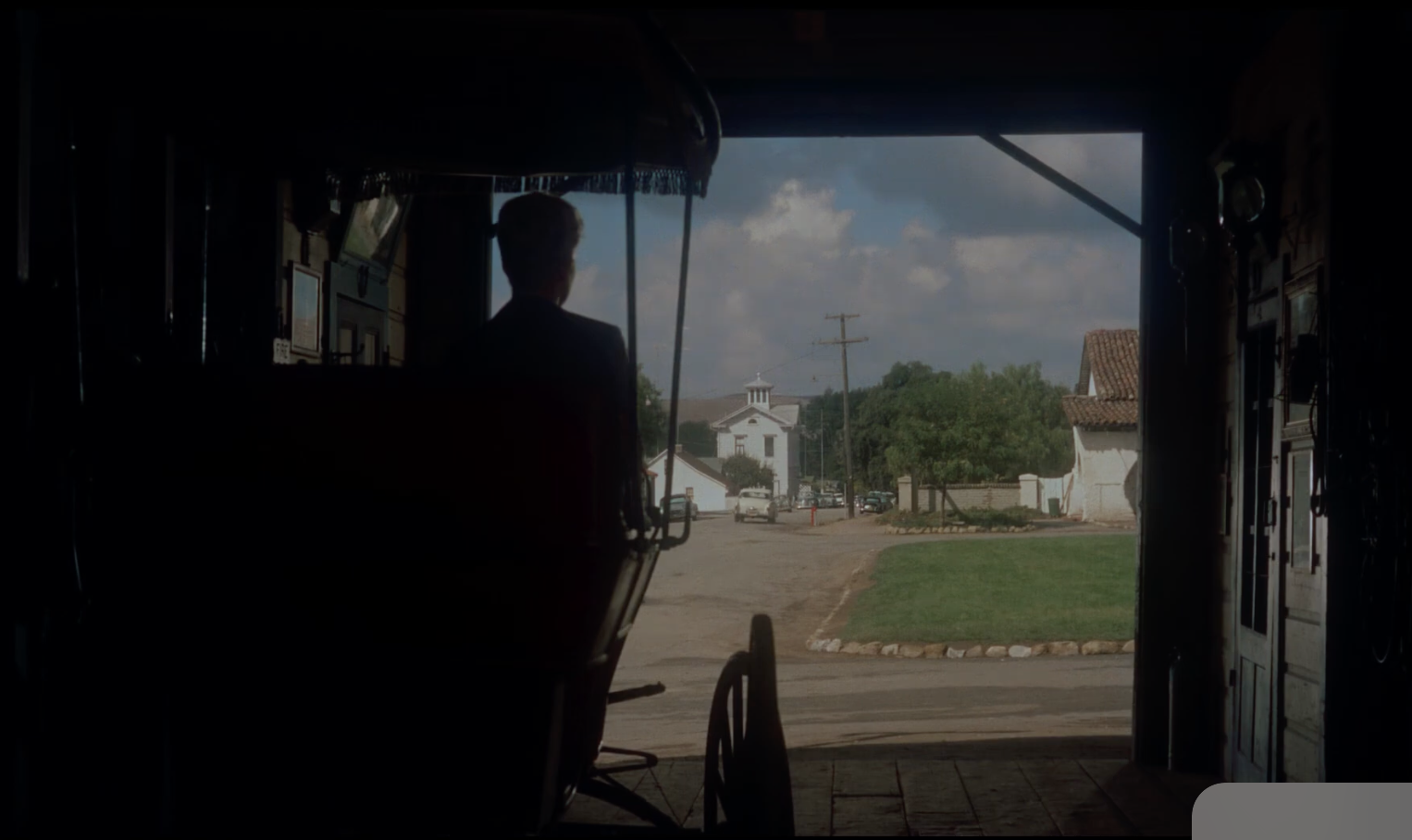
3. Drawn Toward the Light (Mission Barn, 1:15:09–1:15:12)
The third shot occurs after Judy suddenly breaks away from Scottie in the mission barn and runs toward the church tower.
At the beginning of the shot, Scottie walks toward the barn doorway with his back to the camera, searching for where Judy has gone. The visual contrast between spaces is immediate. The interior of the barn is dark and shadowy, while the exterior landscape (bright blue sky and vivid green grass) is flooded with light.
Scottie pauses briefly at the threshold of the doorway, looking out across the field. He then suddenly runs out of the barn, exiting the frame to the right as he pursues Judy.
This moment slightly alters the pattern established in the previous shots. Unlike earlier scenes, Scottie is now in constant motion and moving toward the light rather than remaining trapped in darkness. However, this movement is still entirely motivated by Judy. Moments earlier she fled the barn, leaving him alone in the shadows. His decision to run is therefore a reaction to her sudden departure rather than an independent action.
For most of the shot Scottie remains within the dark interior of the barn, only entering the light at the final second as he exits the frame. Judy’s absence continues to dictate his behavior, reinforcing the idea that she still holds narrative power. Even when Scottie moves toward the light, it is because Judy has compelled him to follow.
Conclusion
Throughout the first hour and a half of Vertigo, Hitchcock uses staging to emphasize the film’s hierarchy of knowledge between Scottie and Judy. In each of the three shots discussed here, Scottie is largely confined to shadowed areas of the frame, while Judy occupies brighter spaces and moves more freely within them.
Although Scottie’s physical mobility gradually increases over time, his movements remain motivated by Judy’s actions. The staging therefore subtly undermines the appearance that Scottie is the active pursuer. Instead, Judy consistently controls the spatial dynamics of the scene.
Even before the narrative explicitly reveals Elster’s deception, these visual patterns signal the underlying truth: for most of the film, Judy possesses knowledge and power that Scottie does not. Hitchcock’s staging quietly places Scottie in the dark — both literally and figuratively.
