Moulin Rouge!
2001, Baz Luhrmann
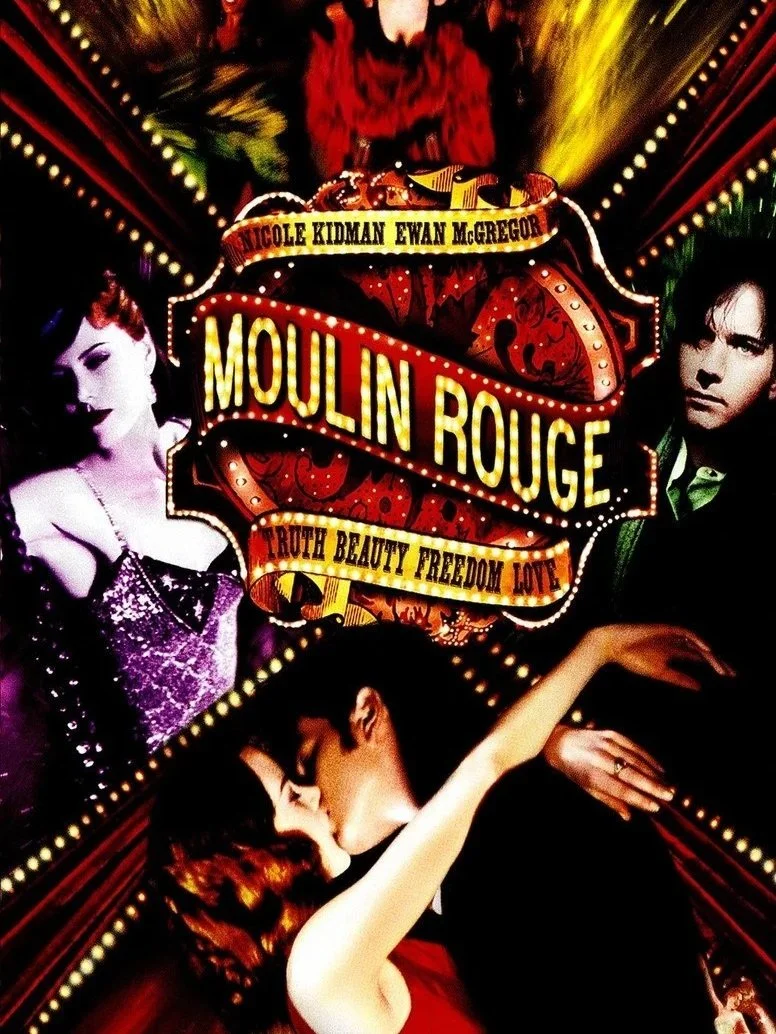
“Campy jukebox musical chaos that somehow becomes pure romance.”
Rating: 5 out of 5
How it sticks: Permanent Take – lives in my brain forever
First Look:
Watching Moulin Rouge! feels like being shot out of a cannon into a technicolor fever dream. From the opening credits where the 20th Century Fox logo is staged behind a live orchestra with a dramatic conductor, the movie immediately tells you what kind of ride you’re in for. It’s frenetic, campy, theatrical, and unapologetically maximalist. If you embrace its weirdness, it’s exhilarating; if you resist it, it’ll probably overwhelm you.
On how it’s made
Editing / pacing
You rarely get more than a second of visual calm before another whip pan, jump cut, sound effect, or sudden shift in perspective. The hyperkinetic editing mirrors the chaos and decadence of the Moulin Rouge itself. Interestingly, the film relaxes visually whenever Christian and Satine sing together. These longer takes and steadier framing ground the story in their romance.
Performances
Ewan McGregor and Nicole Kidman commit completely to the tone. These roles could easily feel awkward or cheesy if played halfway, but both actors dive headfirst into the theatricality. McGregor’s charisma and earnestness make Christian instantly lovable, while Kidman balances seduction, vulnerability, and star power as Satine.
Production design & costume
Every frame is bursting with color, texture, and detail. The costumes and set design feel extravagant but never sloppy, and every visual element truly contributes to the heightened world. It’s no surprise the film won Best Art Direction and Best Costume Design at the 74th Academy Awards.
Theory moment
What is the movie quietly obsessed with?
Performance — both literal and emotional. Everyone in this world is performing in some way whether it be on stage, in society, or in love, and the line between sincerity and spectacle is constantly blurred. The Moulin Rouge thrives on illusion and theatricality, yet the characters often reveal their most genuine emotions through these performances. The film also understands something essential about adapting musicals to cinema: if you’re going to make a movie musical, it should take advantage of what film can do that the stage cannot. Otherwise, what is the point of changing mediums? Moulin Rouge! fully embraces the possibilities of cinema through hyperkinetic editing, impossible visual transitions, sweeping camera movement, and sequences that collapse space, time, and perspective in ways a stage production never could. The performances are not just theatrical moments captured on film; they are cinematic experiences designed specifically for the screen. In doing so, the film turns spectacle itself into storytelling and proves that the movie musical can push beyond the limits of the stage rather than simply replicate it.
One Moment I can’t stop thinking about:
The “Roxanne” tango sequence, specifically the shots of Christian walking between the dancers while singing the bridge.
Why it matters:
It’s one of the most emotionally explosive moments in the film. The choreography, editing, and music all collide to translate jealousy and heartbreak into movement and rhythm. It’s melodrama at full volume, but it works perfectly because the film has committed so completely to its style.
Rewatch value: Demands rewatch. There’s so much visual and musical information flying past you that every viewing reveals something new. Even if you know the story, the energy and spectacle make it endlessly rewatchable.
Key takeaway:
This film is best suited for viewers who are willing to fully surrender to spectacle and embrace a heightened, theatrical style of storytelling. Its campiness, chaos, and maximalist energy are not flaws but the very point of the experience. When you lean into that tone, Moulin Rouge! reveals itself as one of the most inventive movie musicals ever made. It uses the language of cinema to expand what a musical can do, creating moments that simply could not exist on a stage.
