The Talented Mr. Ripley
1999, Anthony Minghella
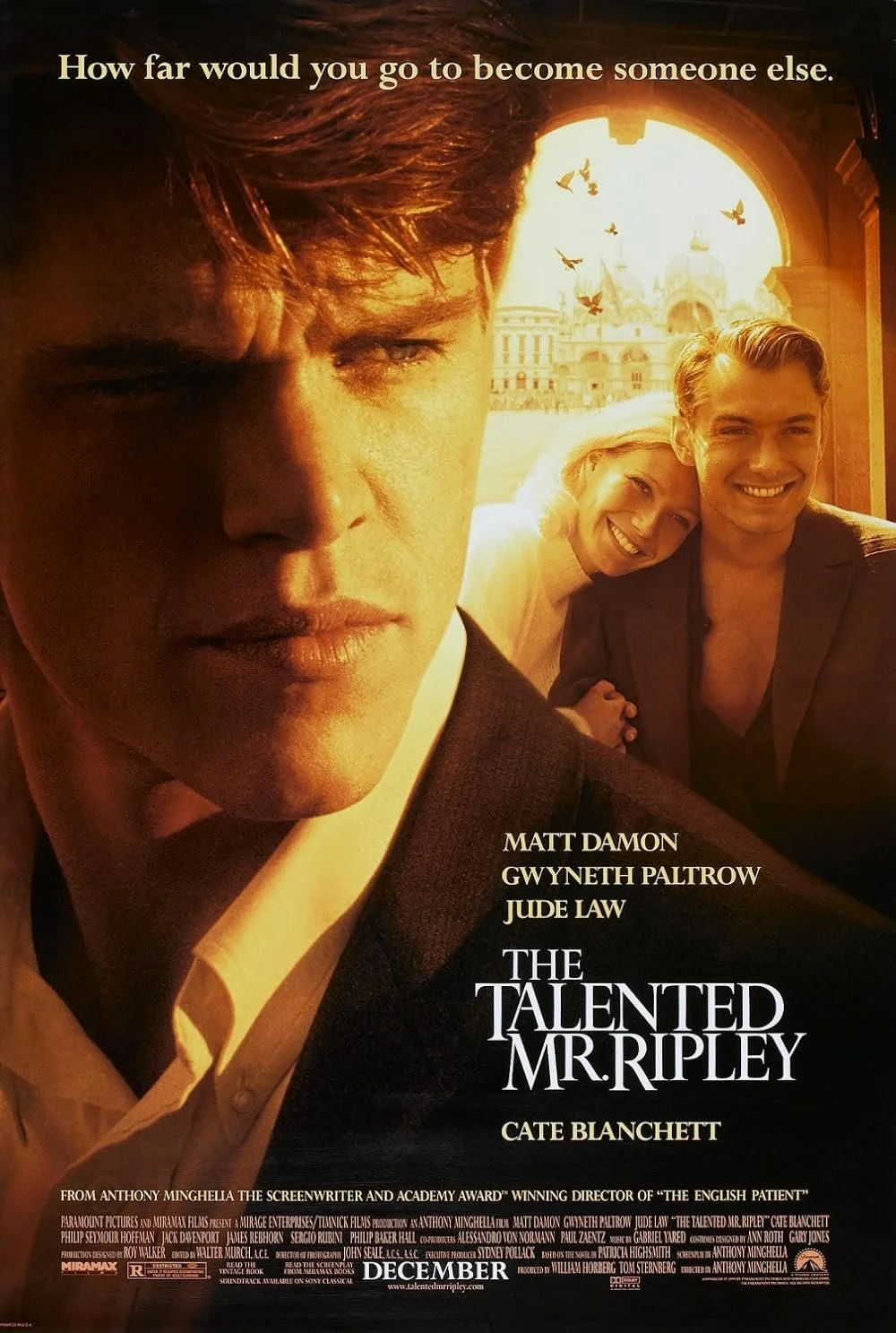
“A sun-drenched descent into someone else’s life”
Rating: 4.5 out of 5
How it sticks: Lingers – the atmosphere and final shot stay with you
First Look:
The opening sequence, particularly the shot of Tom gazing toward the orchestra stage with a subtly tilted camera, immediately signals imbalance. We’re not watching Dickie yet; we’re watching Tom watch a world he wants. The Talented Mr. Ripley announces itself as a film about desire: twisted, aspirational, and just slightly off-balance. The camera doesn’t simply observe Tom; it leans with him, already complicit in his yearning. The first third is full of fluid transitions and identity slippages, visually echoing Tom’s fragmented sense of self as he prepares to charm Dickie. Unlike many modern thrillers, it allows space – for scenery, for silence, for doubt – and trusts the audience to sit with moral ambiguity. For my younger readers, think Saltburn but without the need to shock you into submission.
On how it’s made:
Shot Framing
The on-location shooting (particularly in the European scenes) is intoxicating. The beaches, cafés, piazzas, and interiors feel full and lived in rather than curated. The scenery becomes a character, not just a backdrop. Minghella lets the camera linger long enough for you to feel the seduction of wealth and leisure, which makes Tom’s obsession understandable. Where Saltburn aestheticizes opulence as spectacle, Ripley uses space to show what Tom wants to inhabit. From the moment Tom goes to Europe, we are already inside his warped desire.
Musical Motifs
The score carries a playful secrecy early on — light chimes and whimsical tones accompany Tom’s lies, almost as if the film is winking at us. It’s fun to watch how easily he lies and how comfortable he becomes doing it; the music makes deception feel like a parlor trick. That playfulness turns ominous when Freddie (Philip Seymour Hoffman) introduces the eerie piano motif while verbally dismantling Tom. The tonal shift signals that the game is no longer charming; it’s dangerous.
Performance / Identity as Performance
Matt Damon plays Tom as a man constantly rehearsing himself. His lies aren’t frantic; they’re practiced. You see him clocking reactions, adjusting posture, softening his voice. He is never more alive than when he’s pretending. Compared to Barry Keoghan’s Oliver in Saltburn, who is telegraphed from the start as unstable and predatory, Tom remains elusive. You can’t fully pin him down… which makes him far more compelling.
Film theory moment:
Is Tom an antihero or a void?
The film never fully answers whether Tom desires Dickie, envies him, wants to become him, or all three. That ambiguity is its strength. His identity feels porous. He absorbs the mannerisms and rhythms of those around him until there’s nothing solid underneath. Unlike Saltburn, which loudly declares its themes about class resentment and obsession, Ripley leaves space. It trusts you to wrestle with whether you were rooting for him and why.
(Is it bad that I was?)
One shot I can’t stop thinking about:
The piano scene where Tom reads the letter he wrote to himself as “Dickie,” shifting between voices before collapsing back into Tom.
Why it matters:
Formally, the shot holds on him long enough that the transformation happens in real time. There’s no flashy cut – just a gradual modulation of posture, voice, and facial tension. He swells into Dickie’s confidence and then deflates back into Tom’s insecurity. The piano itself becomes symbolic: performance, imitation, repetition. He is rehearsing a life he desperately wants to inhabit. It’s one of the clearest visualizations of identity as costume and one of the few moments where we see how fragile the illusion really is.
Rewatch value: High! There are too many visual details, musical cues, and performance subtleties to catch in one sitting (not to mention the pleasure of revisiting those sun-drenched locations)
Key takeaway:
The Talented Mr. Ripley is everything Saltburn tries to be — seductive, psychologically complex, morally ambiguous — without mistaking provocation for depth. Gorgeous scenery, sharp framing, and layered performances make it endlessly watchable. Give me atmosphere and ambiguity over shock value every time.
