Performing Cool: The Final Shot of Breathless
In Breathless, Jean-Luc Godard closes his film with a moment that is at once abrupt, disorienting, and strangely revealing. The final sequence, in which Michel collapses after being shot and Patricia watches him die, distills many of the film’s central concerns: performance, self-mythologizing, and the instability of identity. Through staging, gesture, and a direct address to the camera, the scene transforms what might have been a conventional death into something far more ambiguous.
After being shot, Michel does not immediately collapse. Instead, he runs, stumbles, and lingers in a prolonged death that feels at odds with the physical reality of his wound. This delay already signals that the scene is less concerned with realism than with performance. Michel has spent the entire film modeling himself after cinematic icons, particularly Humphrey Bogart, mimicking gestures like rubbing his thumb across his lips and adopting the detached cool of a gangster protagonist. In his final moments, that performance continues. Even as his body fails, he remains committed to the role.
The staging of the scene reinforces this sense of artificiality. Michel ultimately collapses in the same stretch of street where Patricia had been playfully moving earlier in the film, visually linking his death to their earlier interactions. The space does not feel like a site of tragedy so much as a stage, one that has been used repeatedly for performance. As a result, his death reads less like a narrative endpoint and more like the final act in a role he has been rehearsing all along.
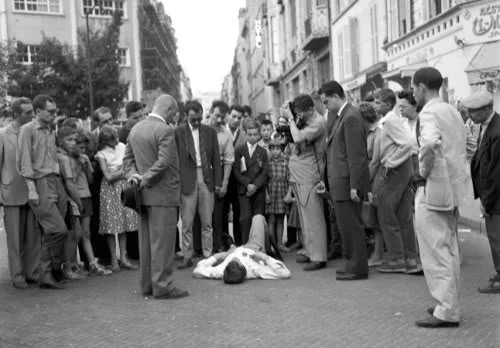
Patricia’s behavior complicates this further. Rather than responding with clear grief, she circles the space, watching Michel while also seeming detached from him. Even before his death, their relationship has been marked by asymmetry. Michel projects desire and meaning onto Patricia, while she remains distant, often unreadable. In this final moment, that distance becomes undeniable. As Michel delivers his last words, which can be read as mocking Patricia’s attempt at emotional sincerity, the scene resists any straightforward sense of romantic tragedy.
The most striking gesture comes after Michel dies. Patricia, who has spent much of the film observing and questioning, turns toward the camera and rubs her lips in a gesture that mirrors Michel’s earlier habit. Throughout the film, Michel performs this gesture as a way of aligning himself with a cinematic ideal of masculinity. When Patricia repeats it, the meaning shifts. The gesture is no longer tied to Michel alone. Instead, it becomes something transferable, a sign that identity in Breathless is not fixed but performed and imitated.
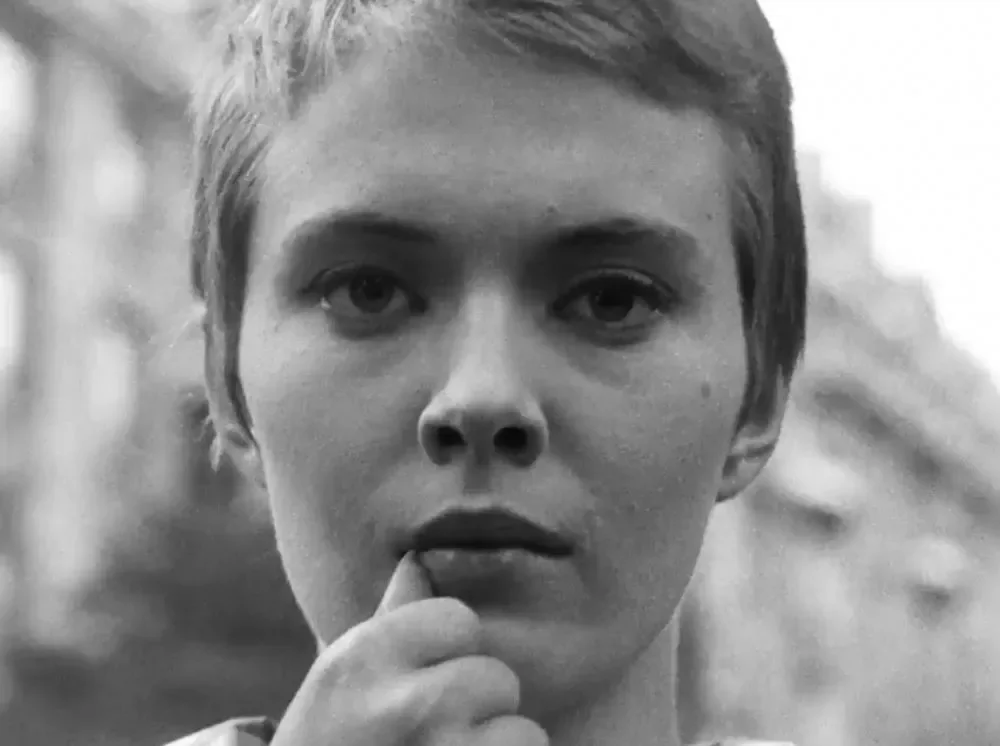
Her direct look into the camera further destabilizes the scene. Like Michel’s earlier moments of breaking the fourth wall, this glance calls attention to the film as a constructed object. It also implicates the viewer. Patricia’s expression is difficult to read. She does not break down, nor does she clearly express remorse. Instead, she seems to be trying on a reaction, much like Michel has been trying on his persona throughout the film. The result is unsettling. The audience is left without a clear emotional anchor, forced to confront the possibility that neither character has been entirely sincere.
In this sense, the final shot encapsulates the broader project of Breathless. The film repeatedly disrupts continuity through jump cuts, spatial disorientation, and narrative digressions, but these formal choices are not arbitrary. They reflect a world in which traditional structures, whether cinematic or emotional, no longer hold. Michel’s death does not resolve the narrative because the film has never been working toward resolution in the first place.
Instead, the ending leaves us with a question: if identity is something performed, borrowed, and imitated, then what, if anything, is authentic? By closing on Patricia’s ambiguous gesture and direct gaze, Godard refuses to answer. The performance continues, even after the story ends.
